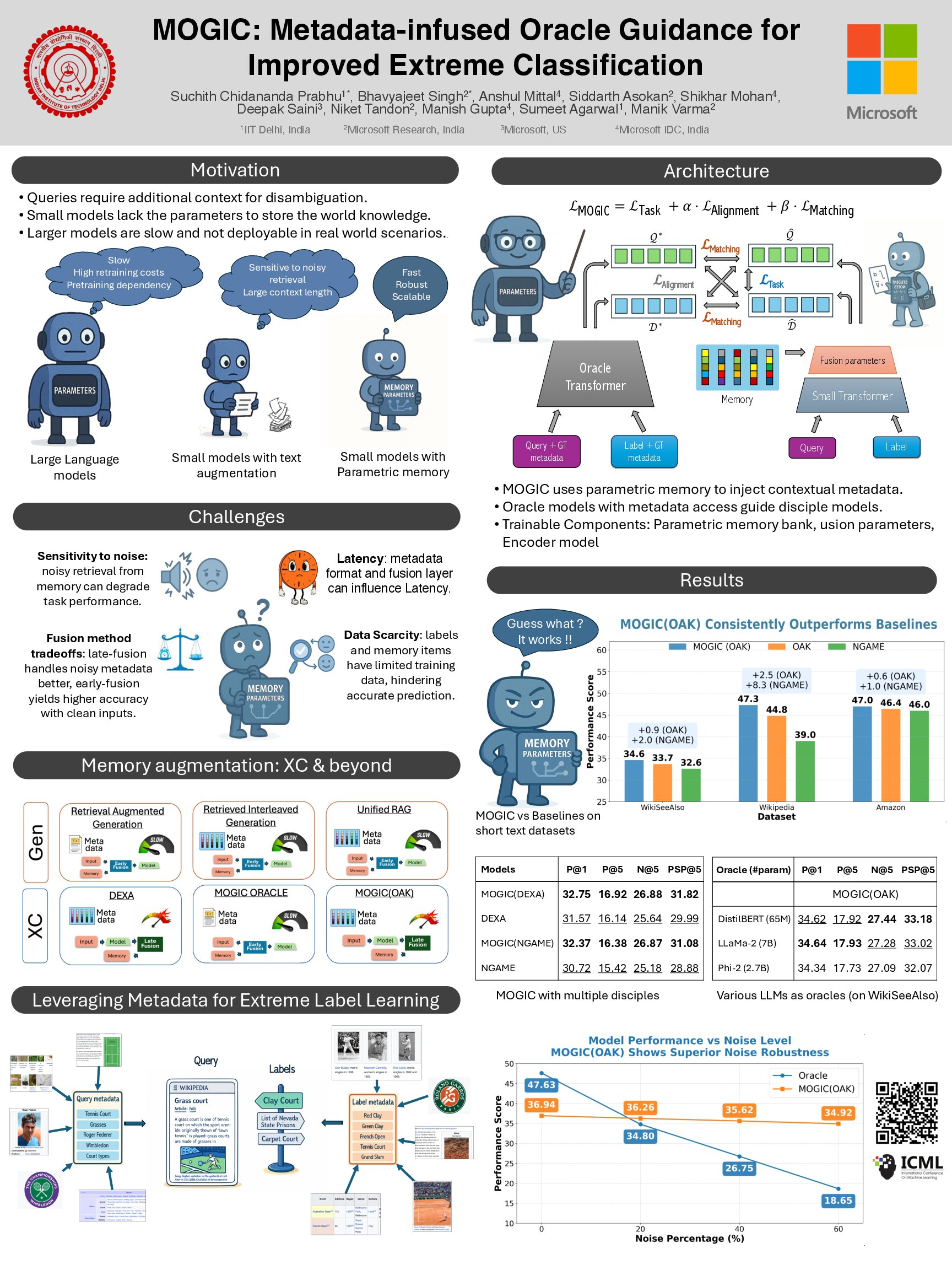
MOGIC: Teaching a Small Model to Think Like an Oracle
Type “grass court” into a search engine and you expect tennis: clay courts, hard courts, Wimbledon. Now imagine a model that also looks up extra context for the query and finds “Landforms” and “Grasslands”. Suddenly it’s recommending articles about Texas and Nevada state prisons. That really happened to a state-of-the-art model in our experiments, and fixing it is what our ICML 2025 paper, MOGIC, is about.
Short queries, millions of labels
In extreme classification (XC), a short query must be matched to the handful of relevant labels out of millions: search queries to advertiser keywords, products to products that are bought together, Wikipedia pages to the categories they belong to. Two things make this hard:
- Queries are tiny. A few words rarely say enough on their own.
- Data is sparse. With millions of labels, most have only a few training examples.
So XC models lean on metadata, extra text that explains the query. A Wikipedia page can be described by the pages it links to or the categories it’s tagged with. A search query can be described by the titles of pages people clicked for it. In the papers and code this metadata is called memory, and each piece of it is a memory item.
The catch: clean, human-curated links to metadata exist at training time, but in production they usually don’t. Around 80–85% of real traffic is cold-start, so the model has to predict which memory items are relevant, and predictions are noisy.
Two ways to use memory
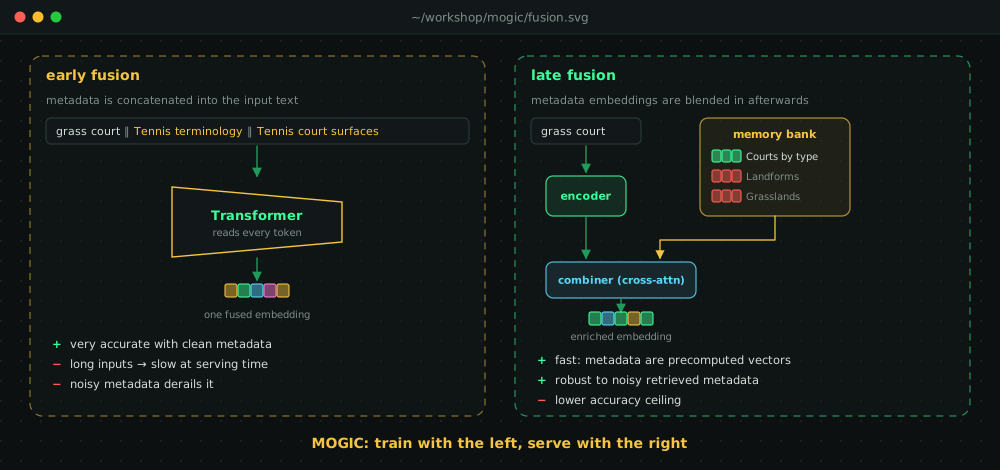
Early fusion simply glues the metadata text onto the query and lets a transformer read it all. With ground-truth metadata it is superb: 47.63 precision@1 (P@1) on LF-WikiSeeAlsoTitles-320K. But longer inputs mean slower serving. And when the metadata is predicted, the model believes whatever it’s handed and falls to 28.49.
Late fusion, used by OAK (the previous state of the art), keeps a memory bank of metadata embeddings. It retrieves a few and blends them into the query embedding with one cross-attention layer. It’s fast and shrugs off noise (33.71 with predicted metadata). But even with perfect metadata it reaches only 38.92, far below early fusion.
One approach is accurate but fragile and slow; the other is fast and robust but has a lower ceiling. MOGIC asks whether we can train with the first and serve with the second.
The MOGIC recipe
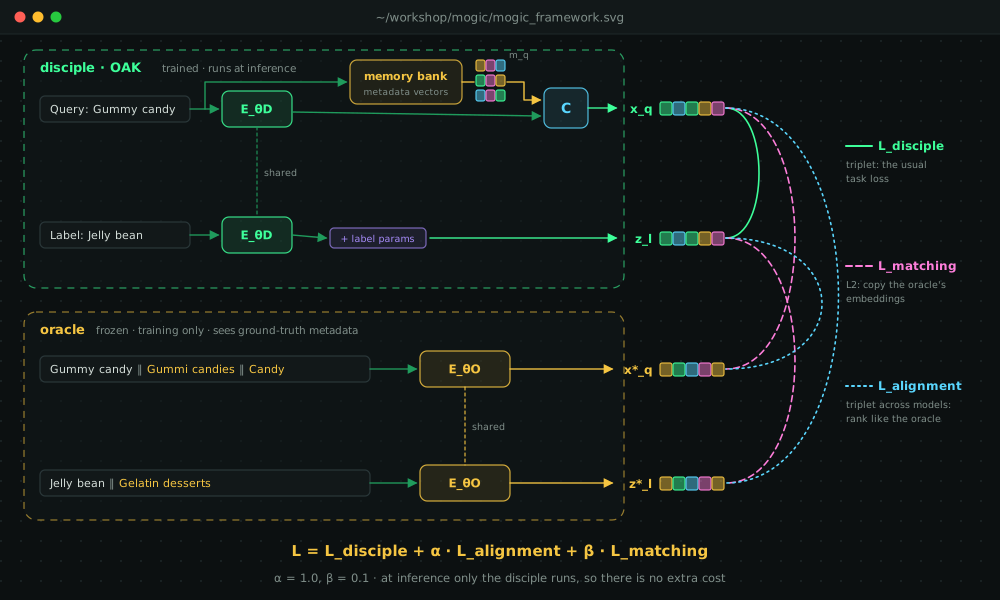
Phase 1: train an oracle
The oracle is an early-fusion encoder that gets privileged information: the query and the label, each concatenated with its ground-truth metadata as text (Gummy candy ‖ Gummi candies ‖ Candy). It’s trained with a standard triplet loss that pulls relevant labels close to the query in embedding space and pushes irrelevant ones away. We tried three oracles: a fully finetuned DistilBERT, and LoRA-finetuned Phi-2 and LLaMA-2.
The oracle is excellent and completely impractical: it needs metadata we won’t have at serving time, and it’s slow. So we never deploy it. It’s a teacher who has seen the answer key.
Phase 2: guide a disciple
The disciple is any fast XC model. Our main one is OAK, which has a shared text encoder, a memory bank with a combiner, and a few free parameters per label. It keeps training on its usual task loss, plus two extra losses that point it toward the frozen oracle:
- Alignment makes the two models rank alike. It is a triplet loss across models: the disciple’s query embedding should rank the oracle’s label embeddings correctly, and vice versa.
- Matching makes the disciple’s embeddings land where the oracle’s do, using a simple L2 distance.
\[ \mathcal{L}_{\text{MOGIC}} = \mathcal{L}_{\text{Disciple}} + \alpha\,\mathcal{L}_{\text{Alignment}} + \beta\,\mathcal{L}_{\text{Matching}}, \qquad \alpha = 1,\ \beta = 0.1 \]
At inference time the oracle disappears. Only the disciple runs, with its usual predicted metadata, so MOGIC adds no serving cost at all.
Isn’t this just knowledge distillation?
It’s a cousin, with three twists. The oracle sees ground-truth metadata the disciple never gets, so it isn’t simply a bigger copy of the student. Knowledge flows from an early-concatenation model into a two-tower, memory-based model, and the memory’s free parameters are shaped by the guidance. And the teacher doesn’t have to be bigger: our recommended oracle is a 65M-parameter DistilBERT, the same size as the disciple.
We also back this with a guarantee. Under simplifying assumptions, a disciple trained with the Alignment and Matching losses has an expected loss at most the oracle’s expected loss, plus a term that shrinks as the number of training samples \(N\) grows:
\[ \mathbb{E}\big[\mathcal{L}_{\text{Disciple}}\big] \;\le\; \mathbb{E}\big[\mathcal{L}_{\text{Oracle}}\big] + \tfrac{4K}{N}(R_q + R_l) + 2\sqrt{\tfrac{\log(1/\delta)}{N}} \]
In words: the disciple can inherit the oracle’s quality.
Results
MOGIC(OAK) beats OAK on every benchmark. Here are precision@1 and propensity-scored precision@5 (PSP@5, which rewards getting rare labels right):
| Dataset | OAK P@1 | MOGIC(OAK) P@1 | OAK PSP@5 | MOGIC(OAK) PSP@5 |
|---|---|---|---|---|
| LF-WikiSeeAlsoTitles-320K | 33.71 | 34.62 | 30.83 | 33.18 |
| LF-WikiTitles-500K | 44.82 | 47.28 | 24.90 | 26.12 |
| LF-AmazonTitles-131K | 46.42 | 47.01 | 49.78 | 50.33 |
The gains show up consistently on tail labels, the rare ones with little training data. It also beats graph-based methods such as GraphFormers and GraphSage by about 8%, even though those were given ground-truth metadata at inference time.
It’s plug-and-play. MOGIC doesn’t need a memory-based disciple. On LF-WikiSeeAlsoTitles-320K it lifts NGAME from 30.72 to 32.37 P@1 and DEXA from 31.57 to 32.75.
Both guidance losses matter. On LF-WikiSeeAlsoTitles-320K, P@1 is 33.71 with the task loss alone. Adding only Alignment gives 34.12, adding only Matching gives 34.11, and adding both gives 34.62. Dropping the task loss and keeping only the guidance falls to 32.70, so the disciple still needs its own objective.
A better oracle isn’t a bigger one. On its own, the DistilBERT oracle reaches 47.63 P@1, while the LoRA-tuned LLaMA-2 manages 34.20 and Phi-2 33.32. Yet as teachers they are almost interchangeable: the disciple reaches 34.62, 34.64 and 34.34 respectively. The 65M model teaches as well as the 7B one.
Robust where the oracle is fragile
This is perhaps the most striking result. We took ground-truth metadata and progressively replaced a share of it with irrelevant items:
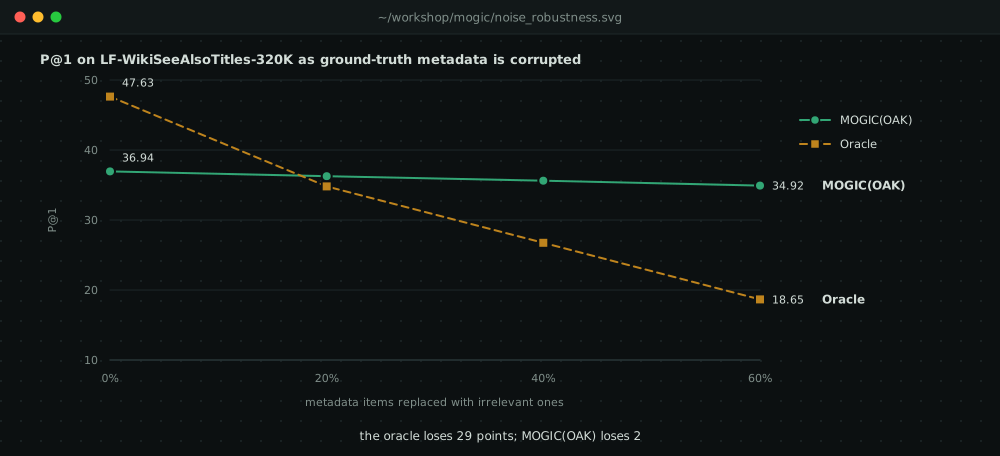
At 60% noise the oracle loses 29 points of P@1, but the disciple it trained loses only 2. Missing metadata is handled just as gracefully: shrinking the memory bank to 40% of its size moves MOGIC(OAK) from 34.62 to only 34.17. The disciple learned what the oracle knows without inheriting how it breaks.
The grass court, revisited
Here are the top-5 predictions for two queries, before and after MOGIC. + marks a correct label and - a wrong one:
For “Grass court”, both models see the same misleading memory items (Landforms, Grasslands). OAK follows them into geography. MOGIC(OAK), shaped by an oracle that knew the query was about tennis court surfaces, keeps the query’s real intent.
Takeaways
- Train with privileged information, serve without it. Ground-truth metadata is too good to waste, even if you can’t use it in production.
- Guidance beats imitation of size. A small oracle with the right information teaches as well as a 7B model.
- Robustness can be distilled selectively. The disciple picked up the oracle’s accuracy but not its fragility.
Read more
- 📄 Paper: OpenReview
- 💻 Code: github.com/suchith720/mogic
This was joint work with Bhavyajeet Singh (equal contribution) and a wonderful team from IIT Delhi, Microsoft Research India and Microsoft, advised by Sumeet Agarwal and Manik Varma.
The poster
Here’s our poster. Click it to zoom, or download the PDF.